I have some time this morning so let's talk about hay. I am not going to go into all the sordid details about every possible combination of hay available, but there are a few things that are important for rabbit owners to know.
#1. I have found that if someone is raising rabbits that hay will be an issue that everyone will have to deal with at some point. I know of breeders that don't include hay with their daily diet, but even then expecting does need nesting material and hay is ideal for this purpose. It is also a great choice for roughage and gives them something to do that is natural and that they seem to enjoy.
#2. There are lots of different kinds of hay available. Not all hays are equal in type or quality.
#3. Greener does not always equal better. We will talk more about this a bit later.
First for number one, I haven't talked about it much, but I have tried several long-term feeding "experiments" over this past year regarding hay. I have kept the pellets the same throughout, have avoided offering garden leftovers during this time, as well as treats. What I have found is this:
#1. Hay cubes are no substitute for hay. I tried several different kinds and only certain rabbits enjoyed them. Others turned up their nose no matter what. The bags also tend to contain a lot of dust and small particles of broken hay from the process. Youngsters may have trouble working the hay loose of the cube.
#2. Rabbits without hay get bored more quickly. All of mine, without exception across the breeds, get excited at hay time. They show outward behavior that they like hay time. This makes sense given they love hay and that grazing is a natural behavior for them.
#3. I had more problems with rabbits going off feed periodically this year when I didn't feed hay and it stopped altogether when I offered hay all the time again. I believe this is due to slowed gut movement if they don't drink enough that day, if they are ingesting hair during a molt, etc. I would add hay and the rabbits would fix themselves.
#4. I tried a number of other bedding materials during my hay projects this year from synthetic nesting material, to recycled litter materials mixed with the doe's fur, etc. Nothing compared to a lovely hay nest that the doe lined with her fur.
Of course hay is not a cure-all for all rabbit behaviors or ailments, but I think it sure helps for a happy and healthy rabbit.
Now let's talk about the kinds of hay available. The most common I've found are alfalfa, timothy, orchard, coastal/Bermuda, oat, and combinations therein.
Here is some information about these kinds.
Alfalfa- this is actually a legume. It is dark green, has more protein, energy, and calcium than grass hays typically and also has a high mineral content. There is a lot of controversy over feeding alfalfa to rabbits regularly, but because our pellets are made up primarily of alfalfa I don't see the point in giving them more than they already get. In my humble opinion, giving a healthy variety to rabbits (within reason) is one of the keys to a healthy diet just like it is with us.
Timothy- this is my favorite kind of hay to offer. It is very balanced in protein and energy, has a nice feel/thickness depending on the cut without ever really being coarse. It is usually lighter shades of green as you saw from my previous post.
Orchard- this hay is higher in fiber and lower in protein than some other kinds of hay, but tends to have a bit more protein than Timothy most of the time. This can start greenish but can also yellow a bit with curing.
Bermuda/Coastal- this hay is typically less expensive than Timothy or Orchard. It is still a lower protein grass hay and is a good fiber source. This is usually shades of green and tanish.
Oat- another higher fiber/lower protein hay. This one is a lot more coarse than some of the others, but the rabbits still seem to enjoy it. This hay is almost straw-yellow colored. It looks almost like straw, but works fine in my experience and is a good winter choice if nothing else is available.
Now lets talk about the cut of hay. This is pretty straight forward. The first cut of hay can be less desirable if it is left too long to mature as this can lend to tough/coarse "stemmy" hay. Most farmers cut before this time though and I have found it to work fine for the most part. I believe the Kaytee Timothy I posted earlier in the week was from a first-cut.
The second cut is typically softer and finer than the first cut. It can have more leaves then stems and feels/smells very nice in my hand. The bunnies don't seem to show a preference for first or second cut, but I like the second cuts for the nesting boxes because it is easier to manipulate into the proper shape for the doe than a coarser first cut. I have also found babies tend towards the softer second cut when they first try hay if given the option of both cuttings.
The third cut is not typically available in my area, but when it has been I wasn't thrilled with it. For one thing it was dustier. I can only assume this is because it didn't have the growth/length as the other cuttings and the equipment gathered some extra bits in with the harvest. It is also pretty soft and fine, tends to be leafy. There is a question of whether this cutting offers a lot nutritionally, but my best advice is just to purchase the second cutting when it is available and store your excess high and dry.
There is way more to talk about concerning hay including nutritional charts, types of bales, when and where to buy, etc., but I just want this to be a basic information post. I am including some links below with more information, but in the meantime these are my preferences for hay:
Clean, dry, smells fresh, low-dust, second-cut Timothy hay, but I rotate kinds of grass hay based on the best quality available in my area seasonally. I have fed all of the hays listed above along with a few others and mixes. I prefer square bales and it is a lot more economical to purchase horse quality hay at the local feed store than to purchase little bags of hay at the pet store, which coincidentally supports local farmers. Best of luck in your hay search and thanks for reading!
Helpful Links:
http://www.uky.edu/Ag/AnimalSciences/pubs/id146.pdf
http://www.hobbyfarms.com/crops-and-gardening/hay-feeding-14792.aspx
http://www.atascaderofeed.com/hay.html
Monday, February 20, 2012

Thursday, February 16, 2012
Timothy Hay
I've been short on time lately, but I would like to make a post soon discussing the types hay, feeding options, and the results of some hay "experiments" I've played around with over the past couple of years with rabbits.
In the meantime, I just wanted to show comparison of two cuts of the same kind of hay from different sources so you can see how much it can vary.
The first set of pictures is the standard Kaytee brand of timothy hay from PetSmart. It was on "sale" for $12 per little bag:

And here it is out of the bag today. Sorry about the lighting, but it has been alternating with rain and fog most of the day so I was doing the best I could:

As you can see, it is fairly green with thick stems. Looks pretty much like what it is supposed to be- pure timothy:


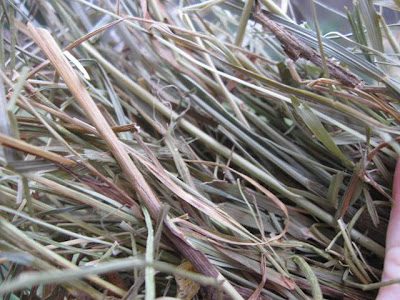
It is also called timothy, but there is some other stuff in there, too:

I see sweet clover among others. Still good eatin', but quite different from what can be purchased from the chain pet store. Part of the difference may be which cut was packaged and shipped from the first bag, but part of it may be other factors from mass production. More to come when I can sit down and type for a while. Thanks for reading!
In the meantime, I just wanted to show comparison of two cuts of the same kind of hay from different sources so you can see how much it can vary.
The first set of pictures is the standard Kaytee brand of timothy hay from PetSmart. It was on "sale" for $12 per little bag:

And here it is out of the bag today. Sorry about the lighting, but it has been alternating with rain and fog most of the day so I was doing the best I could:

As you can see, it is fairly green with thick stems. Looks pretty much like what it is supposed to be- pure timothy:

And below we have more timothy hay, but this is a locally-harvested bale from the horse/feed shop. I believe I paid $11 for a bale yesterday:

Still green, but obviously it has thinner stems and it feels softer in my hand:


I see sweet clover among others. Still good eatin', but quite different from what can be purchased from the chain pet store. Part of the difference may be which cut was packaged and shipped from the first bag, but part of it may be other factors from mass production. More to come when I can sit down and type for a while. Thanks for reading!
Tuesday, February 7, 2012
New Zealand Kits
I realized this morning I never actually posted the rest of the pictures of the kits I took last week. This is from a NZR X NZW pairing. Here they are:

The lighting was nice finally after all the storms we had, so I could get some decent up-close shots:

I believe I mentioned it before, but the black kit is a gold-tipped steel:

This buckling has the best rufous in the litter:

They are very curious and friendly. I guess this shouldn't be too surprising considering they were half bottle-raised:

If I am not already overrun with boys, I will probably keep this little fellow:

Thanks for looking!

The lighting was nice finally after all the storms we had, so I could get some decent up-close shots:

I believe I mentioned it before, but the black kit is a gold-tipped steel:

This buckling has the best rufous in the litter:

They are very curious and friendly. I guess this shouldn't be too surprising considering they were half bottle-raised:

If I am not already overrun with boys, I will probably keep this little fellow:

Thanks for looking!
Saturday, February 4, 2012
Hoppin' Circle January Wrap Up

Fisher Farms shows us her wonderful
show results and ribbons. Congrats Clint on your first leg!
The Kelfla Project shares some scientific tidbits centered around rabbits.
Bella's Rabbitry tells us about
new stock she has coming in, and announces that she isn't selling out completely, after all.
At Home Pets tells us of a nice experience she had with a buyer.
4 Kings Rabbitry gives us a peak inside her extremely organized rabbitry by showing us her binder.
The Rabbit Shepherd shows that even rabbits can be supermodels.
Breeding goals are always important to have in a rabbitry. Hendricks Hearth shares some of theirs.
Rabbit Smarties is back to blogging with her post on the Rocky Syndrome.
The Fuzzy Patch shares some great changes they have planned for their herd.
The Nature Trail shows off an adorable picture of a Smoke Pearl Netherland Dwarf.
Tuesday, January 31, 2012
Baby Harlie Pics
Finally, right? Well, here they are in all their furry glory:

I couldn't barely fit the little chunkers all into the basket, so next time I will probably do individual shots of the keepers.

They are very friendly like most Harlequins, but also because this litter in particular has been handled pretty much constantly since the day they were born.

You can't tell, but there is another Harlie kit tunneling around the others at the bottom of the basket in this pic, lol. You can just barely see one ear sticking up between the two in the front:

This buckling in the front is large and typey so far, plus he has a very nice face split with properly alternating ears. He might need to stay if I do not end up overloaded on boys:

Tentatively, it looks like 5 bucks and only 2 does. I really needed more girls to choose from, but I am still so thankful for another Harlie litter so I can hardly complain. :o)
Thanks for looking. NZ are next up!

I couldn't barely fit the little chunkers all into the basket, so next time I will probably do individual shots of the keepers.

They are very friendly like most Harlequins, but also because this litter in particular has been handled pretty much constantly since the day they were born.

You can't tell, but there is another Harlie kit tunneling around the others at the bottom of the basket in this pic, lol. You can just barely see one ear sticking up between the two in the front:

This buckling in the front is large and typey so far, plus he has a very nice face split with properly alternating ears. He might need to stay if I do not end up overloaded on boys:

Tentatively, it looks like 5 bucks and only 2 does. I really needed more girls to choose from, but I am still so thankful for another Harlie litter so I can hardly complain. :o)
Thanks for looking. NZ are next up!
Saturday, January 28, 2012
Excuses
I just wanted to post that I didn't forget about the blog, but I've been much busier this week than I had anticipated. My preceptorship for school is 7P-7A so I am not getting a whole lot done during the day. This is primarily because I am trying to sleep when I am not catching up on schoolwork. I also had a cold that I am now just getting over.
So.. basically, I am just listing a bunch of excuses, lol. Sorry! To give a brief update, everyone is doing great including all 12 of the Harlie and NZ babies. I'll get back to regularly scheduled programming here shortly (and new pictures, too). Thanks for your patience!
So.. basically, I am just listing a bunch of excuses, lol. Sorry! To give a brief update, everyone is doing great including all 12 of the Harlie and NZ babies. I'll get back to regularly scheduled programming here shortly (and new pictures, too). Thanks for your patience!
Saturday, January 21, 2012
Litter Updates
Just thought I'd post a quick update. I wanted to take pictures today outside of the older two litters, but there is a major thunderstorm going on right now. I'll try to get it to though as soon as the weather cooperates.
New Zealands- all 5 are in with Kari, who has her paws full with the two litters. The black kit that I bottle-fed most of its young life is definitely a GT steel.
Harlequins- all 7 are running wild and driving their mamma crazy. One kit is so active that I don't know how much time she is taking to eat and always feels on the skinny side. I am trying to give her extra time with Kari to compensate for this apparent abundance of energy. I also decided to practice what I preach and cull the runt of the older Harlequin litter from the herd. She was nicely marked, but just had terrible growth and poor size. Valkyrie was almost twice as large when I compared the two, so that is interesting to see the differences even within the same litter.
Mini Lops- Dove's 3 and Serenity's 4 are all still with us and appear to be okay at the moment, though they are still really young. I always consider the first week to be a dangerous time since they are so tiny and fragile. Edit 01/28: I found Dove's kits dead against the side of the nestbox. It looks like she squished them, which really irritates me. Second edit 01/31: Now I am just mad. Serenity killed the two largest of her kits this morning, so only the runt and one other kit are left. I saw how it happened, too. When I was feeding everyone, I turned around just in time to see her (and Dove coincidently, who is in a stacker next to her) jumping in and out of her nestbox over and over again in a food craze, effectively stomping two of her own in her excitement to eat. The only reason she was even out of food is because she had apparently dug her pellets out for no apparent reason overnight. That is just poor mothering on her part- of course jumping up and down on kits isn't going to have a good ending. I don't know why does that were already proven and did fine before are giving me problems right now.
In other news, I am sad to say that I had to euthanize my beautiful NZR buck, Scorch. He developed what appeared to be pneumonia suddenly, though I don't know what caused it. These are never easy decisions, but this is the reality that a responsible breeder has to deal with. As great as it would be to just enjoy the good, dealing with the bad is just another part of raising animals.
New Zealands- all 5 are in with Kari, who has her paws full with the two litters. The black kit that I bottle-fed most of its young life is definitely a GT steel.
Harlequins- all 7 are running wild and driving their mamma crazy. One kit is so active that I don't know how much time she is taking to eat and always feels on the skinny side. I am trying to give her extra time with Kari to compensate for this apparent abundance of energy. I also decided to practice what I preach and cull the runt of the older Harlequin litter from the herd. She was nicely marked, but just had terrible growth and poor size. Valkyrie was almost twice as large when I compared the two, so that is interesting to see the differences even within the same litter.
Mini Lops- Dove's 3 and Serenity's 4 are all still with us and appear to be okay at the moment, though they are still really young. I always consider the first week to be a dangerous time since they are so tiny and fragile. Edit 01/28: I found Dove's kits dead against the side of the nestbox. It looks like she squished them, which really irritates me. Second edit 01/31: Now I am just mad. Serenity killed the two largest of her kits this morning, so only the runt and one other kit are left. I saw how it happened, too. When I was feeding everyone, I turned around just in time to see her (and Dove coincidently, who is in a stacker next to her) jumping in and out of her nestbox over and over again in a food craze, effectively stomping two of her own in her excitement to eat. The only reason she was even out of food is because she had apparently dug her pellets out for no apparent reason overnight. That is just poor mothering on her part- of course jumping up and down on kits isn't going to have a good ending. I don't know why does that were already proven and did fine before are giving me problems right now.
In other news, I am sad to say that I had to euthanize my beautiful NZR buck, Scorch. He developed what appeared to be pneumonia suddenly, though I don't know what caused it. These are never easy decisions, but this is the reality that a responsible breeder has to deal with. As great as it would be to just enjoy the good, dealing with the bad is just another part of raising animals.
Subscribe to:
Posts (Atom)